
Do Outdoor Saunas Really Work in Canadian Winters?
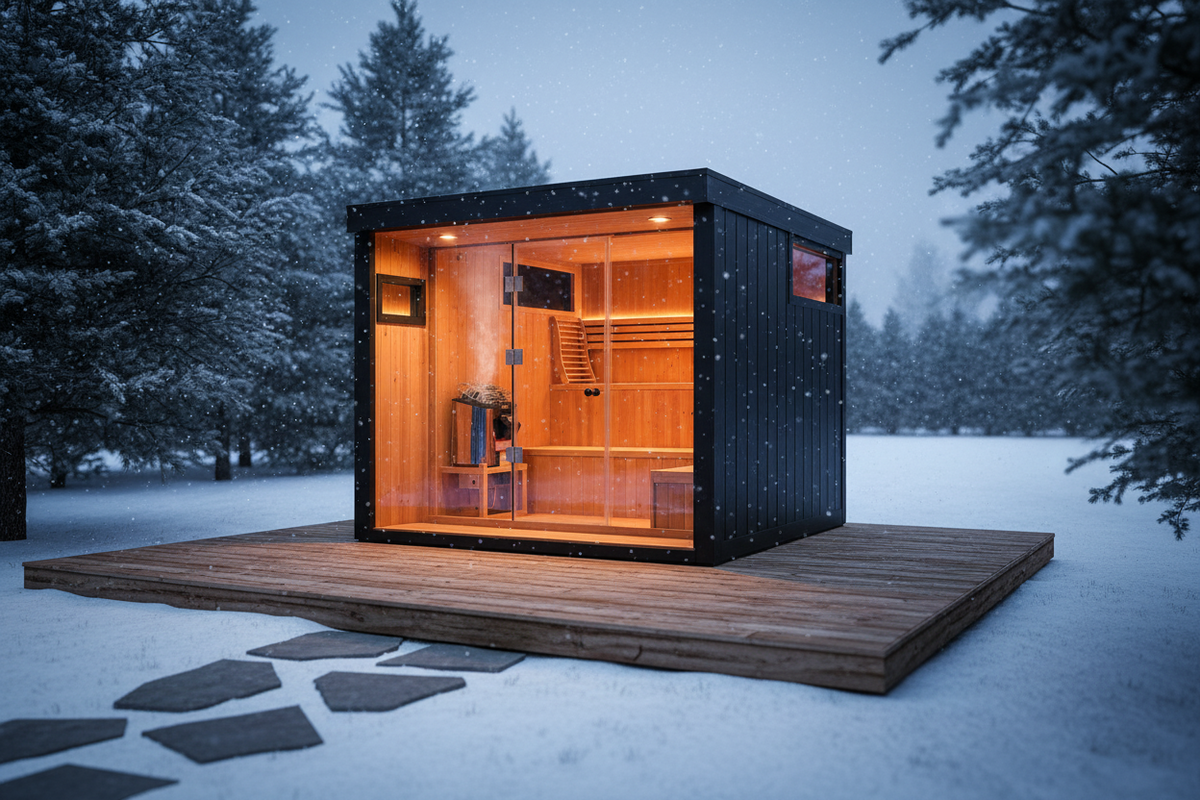
Canadian winters are exactly when many people want a sauna most.
But when outdoor temperatures drop well below freezing, an obvious question comes up:
Can an outdoor sauna actually stay hot and perform properly through a Canadian winter?
The short answer is yes — an outdoor sauna can work in cold Canadian conditions, but its performance depends heavily on how it is designed, insulated, heated and protected from moisture and weather.
A sauna that performs well in mild weather is not automatically well suited to a freezing Canadian winter.
Here are the most important factors to understand before purchasing an outdoor sauna for year-round use.
Why Canadian Winter Changes the Equation
A sauna is intentionally heated to a much higher temperature than the outdoor environment.
During a Canadian winter, the temperature difference between the inside and outside of the sauna can become substantial.
Heat naturally moves from warmer areas toward colder areas, which means the sauna's building envelope — including the walls, ceiling, doors and windows — becomes particularly important in cold weather.
Natural Resources Canada explains that insulation slows the rate of heat loss through a building envelope, while air sealing and moisture control also play important roles in cold-climate building performance.
In practical terms, an outdoor sauna needs more than a powerful heater. The entire structure has to work together.
1. Insulation Matters in a Winter Sauna
Insulation is one of the key factors affecting how efficiently a heated structure retains warmth.
Natural Resources Canada describes insulation as a material layer that slows heat loss to the outdoors.
For an outdoor sauna, this means the walls and especially the ceiling should be designed to limit unnecessary heat loss.
A well-designed thermal envelope can help the sauna:
• Reach operating temperature more effectively
• Maintain a more consistent interior temperature
• Reduce unnecessary heater demand
• Improve comfort during cold weather
However, insulation should not be considered by itself.
The building also needs appropriate air and moisture control because sauna use produces warm, humid air.
2. Why the Ceiling Is Particularly Important
HUUM's sauna-planning guidance recommends insulating the sauna ceiling and notes that reducing unnecessary sauna-room volume can also reduce the amount of heating capacity required.
This is important because heater capacity is selected partly according to the volume of the sauna room.
A sauna with excessive interior volume requires more heating energy than a more compact room with otherwise similar construction.
For a Canadian outdoor sauna, thoughtful ceiling and room design therefore contribute to both comfort and heater performance.
3. The Heater Must Be Correctly Sized
One of the biggest mistakes in sauna design is choosing a heater based only on appearance or assuming that any heater will work for any room.
Both Harvia and HUUM provide heater-sizing guidance based on the volume and construction of the sauna.
Harvia states that an average starting point is approximately 1 kW of heater power for each cubic metre of sauna volume, although the actual requirement changes depending on the structure.
The calculation becomes especially important when the sauna contains significant areas of glass, masonry or other non-insulated surfaces.
That means heater selection should be based on the actual sauna design rather than a simple one-size-fits-all rule.
4. Large Glass Areas Affect Heater Sizing
Large windows can create the open, premium feeling many people want in an outdoor sauna, but glass also affects the heater calculation.
Harvia's heater-sizing guidance states that window surfaces and other non-insulated or heat-storing surfaces increase the required heater capacity.
HUUM similarly instructs customers to include glass doors, glass walls and other uninsulated surfaces when calculating the effective size of a sauna room.
This does not mean a winter sauna should not have glass.
It means the heater and overall structure need to be designed with that glass area in mind.
5. A Bigger Heater Is Not Automatically Better
Correct heater sizing is about matching the heater to the room.
An undersized heater may need to operate longer and harder to bring the sauna to temperature. Harvia specifically warns that insufficient heating capacity can force the heater to run more intensively and may reduce its service life.
At the same time, simply installing the largest possible heater without considering the manufacturer's room-volume range and installation requirements is not the correct approach either.
Heater selection should follow the manufacturer's specifications for the sauna's calculated volume and construction.
6. Make Sure the Heater Is Suitable for Cold Outdoor Installation
This is a detail that Canadian buyers should not overlook.
Not every sauna-heater configuration behaves the same way when the sauna itself is sitting unheated in freezing temperatures.
For example, Harvia advises that certain heaters using mechanical timer switches and thermostats can experience overheat-protector issues when the ambient temperature falls below approximately -5°C.
Harvia therefore does not recommend those particular configurations for an outdoor sauna with no basic heating where the interior can fall below 0°C during winter.
The lesson is not that electric heaters cannot work in Canadian winters.
The lesson is that the exact heater and control system should be selected for the intended installation environment.
Always check the manufacturer's requirements for the specific heater model rather than assuming every system is suitable for an unheated outdoor structure.
7. Moisture Management Is Just as Important as Heat
A sauna does not only produce heat. It also creates moisture.
Natural Resources Canada identifies moisture as a major cause of building-envelope damage and explains that moisture can enter a structure as rain, snow, ice, groundwater or indoor water vapour.
Cold weather makes moisture management especially important because warm, humid indoor air can come into contact with colder surfaces and condense into liquid water or frost.
NRCan notes that uncontrolled condensation within a building envelope can contribute to reduced insulation performance, mould and structural damage.
This is why a properly designed winter sauna should address:
• Exterior weather protection
• Interior moisture control
• Air sealing
• Appropriate vapour control
• Drainage and drying
• Ventilation
8. Ventilation Still Matters in Winter
It may seem logical to seal an outdoor sauna as tightly as possible during winter, but sauna design still needs controlled ventilation.
The objective is not uncontrolled air leakage.
Instead, the sauna should have a ventilation strategy appropriate to its heater and construction so fresh air can enter and humid air can leave as intended.
This helps the sauna operate as designed and assists with drying after use.
Always follow the ventilation requirements provided by the sauna and heater manufacturer.
9. Snow and the Roof Cannot Be Ignored
A Canadian outdoor sauna is also an outdoor structure, which means the roof must deal with real Canadian weather.
The National Research Council of Canada notes that roof design requirements consider snow and rain loads, with required loads varying according to geographic location and other design factors.
Snow load is about weight, not simply the visible depth of snow.
Wet, dense snow can impose a very different load from light, fluffy snow.
When purchasing an outdoor sauna, Canadians should therefore consider whether the structure and roof are appropriate for local conditions and whether local building requirements apply.
10. Snow and Water Should Be Managed Around the Sauna
Moisture does not only come from inside the sauna.
NRCan identifies snow, rain, ice, runoff and groundwater as exterior sources of moisture that can affect structures.
An outdoor sauna should therefore be located on an appropriate base with sensible drainage around the structure.
The surrounding area should not encourage standing water or repeated moisture exposure against the building.
Proper site preparation is part of creating a durable outdoor installation.
11. Expect Winter Heat-Up Time to Vary
There is no single accurate statement such as “every outdoor sauna reaches temperature in 30 minutes.”
Heat-up time depends on multiple factors, including:
• Outdoor temperature
• Sauna-room volume
• Heater output
• Insulation
• Glass area
• Interior starting temperature
• Construction materials
• Ventilation
• Desired sauna temperature
On an extremely cold day, an outdoor sauna may naturally require more heating than it would during mild weather.
That does not mean the sauna is failing.
The more useful question is whether the sauna, heater and envelope were designed to work together for the conditions in which they will be used.
12. Do Outdoor Saunas Lose All Their Heat Through Glass?
No, but glass has to be considered during design.
Both Harvia and HUUM specifically incorporate glass surfaces into their heater-sizing calculations because glass and other non-insulated surfaces increase the calculated heating requirement.
This means a panoramic window or large glass door can still be part of a winter sauna, provided the sauna's heater and construction are appropriately specified.
13. What Should Canadians Look for When Buying an Outdoor Sauna?
If year-round use is the goal, do not evaluate an outdoor sauna on appearance alone.
Ask practical questions about the complete system.
Insulation
Ask how the walls and ceiling are constructed and how the sauna limits heat loss in cold weather.
Heater Capacity
Confirm that the heater is properly matched to the calculated sauna-room volume, including glass and other uninsulated surfaces.
Cold-Weather Compatibility
Check whether the exact heater and control system are suitable for an outdoor sauna that may sit below freezing between sessions.
Glass
Large glass surfaces should be accounted for when sizing the heater.
Weather Protection
The exterior should be designed to handle rain, snow and repeated seasonal exposure.
Roof
Consider local snow conditions and applicable building requirements rather than assuming every outdoor structure is suitable for every region of Canada.
Moisture and Ventilation
Look for a design that manages both the moisture generated inside the sauna and exterior weather exposure.
Foundation and Drainage
The sauna should sit on a stable, appropriate base with water managed away from the structure.
So, Do Outdoor Saunas Really Work in Canadian Winters?
Yes — when the sauna is properly designed for outdoor, cold-weather use.
The physics do not change simply because the temperature falls below freezing.
A heater adds heat while the building envelope slows heat loss. The key is making sure the heater capacity, insulation, glass area, moisture management and overall construction are properly matched.
Canadian winter should therefore be treated as a design requirement rather than a reason to avoid an outdoor sauna.
For buyers, the important question is not simply:
“Does this sauna get hot?”
A better question is:
“Was this sauna designed as a complete system for the climate where I plan to use it?”
Built for Sauna Season in Canada
At Solitude Sauna, we believe an outdoor sauna should be something Canadians can look forward to using when winter arrives — not something that becomes unusable as soon as temperatures drop.
Explore our outdoor sauna collection and compare the sizes, layouts and heater options available for your backyard.
Research & References
The technical information in this article was developed using Canadian building-science guidance and sauna-heater manufacturer documentation, including:
1. Natural Resources Canada.
“Keeping The Heat In — How Your House Works.” Guidance on insulation, heat loss, air leakage, condensation and moisture management.
View Natural Resources Canada guidance
2. Natural Resources Canada.
“Condensation.” Guidance on cold-weather condensation, windows, air circulation and energy-efficient glazing.
View Natural Resources Canada guidance
3. Harvia.
“How Do I Select the Correct Heater Power?” Manufacturer guidance covering sauna volume, heater output, windows, glass and other non-insulated surfaces.
View Harvia heater-sizing guidance
4. HUUM.
“Sauna Heater Size Calculator.” Manufacturer guidance explaining how sauna dimensions, outdoor installation and uninsulated surfaces affect heater selection.
View HUUM heater calculator
5. Harvia.
“The Heater Does Not Heat Up in Cold Conditions.” Model-specific technical guidance concerning certain mechanical timer and thermostat heaters in cold outdoor environments.
View Harvia cold-condition guidance
6. National Research Council Canada.
“Codes Canada — Frequently Asked Questions.” Guidance regarding geographic snow loads and roof design requirements in Canada.
View NRC guidance
This article provides general educational information. Building, electrical, installation and permit requirements can vary by province, municipality and property. Always follow the sauna and heater manufacturer's installation instructions and confirm applicable local requirements before installation.