
How Often Should You Use a Sauna? Temperature, Time & Weekly Routine
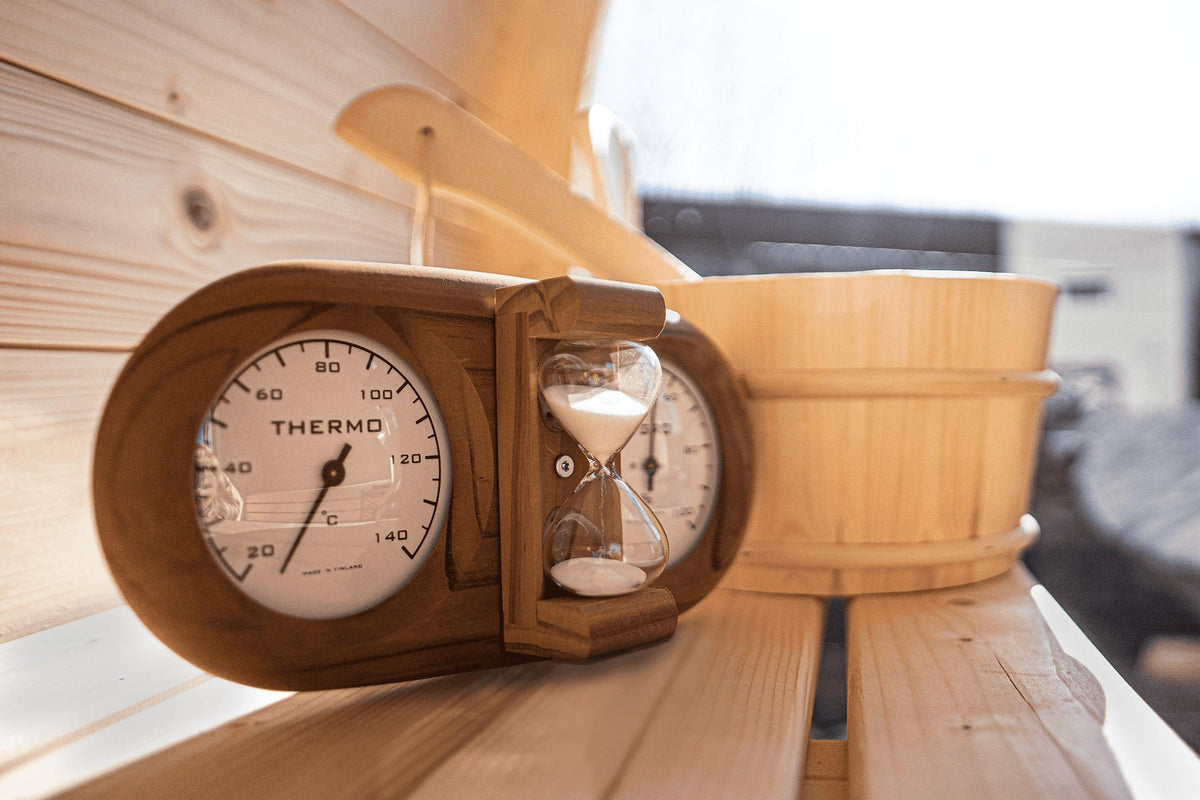
Once sauna becomes part of your routine, a few practical questions usually come up:
How often should you use a sauna? How long should you stay inside? And what temperature should you use?
There are plenty of confident answers online, but the research is more nuanced.
Studies have examined different sauna frequencies and session lengths, and some long-term Finnish research has found associations between more frequent sauna bathing and favourable cardiovascular outcomes. However, researchers have not established one ideal sauna schedule that applies to everyone.
This guide separates what published research tells us from practical safety guidance so you can build a routine around comfort rather than extremes.
How Often Should You Use a Sauna?
There is currently no scientifically established weekly sauna frequency that is ideal for every healthy adult.
A major 2018 systematic review of 40 clinical studies concluded that regular dry sauna bathing may have health benefits, but also stated that more research is needed to determine the optimal frequency and duration for specific health outcomes.
That is important because it means claims such as “everyone should sauna every day” or “exactly three sessions per week is best” go beyond what the evidence currently proves.
What Do the Finnish Sauna Studies Tell Us?
Some of the best-known long-term research comes from Finland.
A prospective study published in JAMA Internal Medicine followed 2,315 middle-aged Finnish men for a median of approximately 20.7 years.
Participants reported sauna use in three frequency groups:
• Once per week
• Two to three times per week
• Four to seven times per week
Researchers found that more frequent sauna bathing was associated with lower rates of sudden cardiac death, fatal cardiovascular disease and all-cause mortality.
Another Finnish prospective study involving both men and women also found an association between increasing sauna frequency and lower cardiovascular mortality.
However, both findings need to be interpreted carefully.
These were observational studies. They show an association, but they do not prove that increasing sauna frequency itself directly causes a longer life or prevents cardiovascular disease.
Lifestyle, physical activity and other health factors may also influence the results.
Does That Mean You Should Sauna 4–7 Times Per Week?
No. The Finnish research should not be treated as a prescription telling everyone to sauna four to seven times per week.
The studies observed the habits and outcomes of specific populations. They were not clinical trials assigning every participant a particular sauna routine to determine the ideal frequency.
A better interpretation is that frequent sauna use has been associated with favourable outcomes in long-term research, while the ideal frequency for individual users remains uncertain.
Your own health, experience, heat tolerance, hydration and lifestyle should influence how often you use your sauna.
How Long Should You Stay in a Sauna?
Session duration is another area where it is easy to confuse observational research with practical safety guidance.
In the Finnish mortality study, researchers compared sauna sessions lasting:
• Less than 11 minutes
• 11–19 minutes
• More than 19 minutes
Longer sessions were associated with lower rates of some fatal cardiovascular outcomes compared with sessions under 11 minutes.
Again, that does not mean people should deliberately stay inside for more than 19 minutes to achieve a health benefit.
For practical sauna safety, Harvard Health recommends staying in a sauna for no more than approximately 15–20 minutes at a time, cooling down gradually and drinking water afterward.
What If You Are New to Sauna?
Beginners do not need to start with a full 15–20 minute session.
Cleveland Clinic advises new sauna users to begin with a short period — potentially around five minutes — and gradually increase the duration as they become familiar with how their body responds to heat.
The most important rule is simple:
You do not need to remain in the sauna until a timer tells you to leave.
If you feel uncomfortable, dizzy, weak, nauseated or unwell, end the session and cool down.
What Temperature Should a Traditional Sauna Be?
Traditional dry saunas operate at significantly higher air temperatures than many infrared sauna systems.
Harvard Health describes a typical Finnish sauna temperature as approximately 175°F (about 79°C), while dry sauna temperatures can reach around 185°F (85°C).
That does not mean the highest available temperature is automatically the best temperature.
Comfort and individual tolerance matter.
Sauna temperature is also only one part of the experience. Humidity, airflow, the amount of water placed on the stones, where you sit inside the sauna and how long you remain inside can all influence how intense the heat feels.
Hotter Does Not Mean Healthier
There is no good reason to turn sauna bathing into a competition to tolerate the highest possible temperature.
Higher temperatures create greater thermal stress, and your goal should be a comfortable sauna experience rather than reaching a maximum number on the thermometer.
If a lower temperature allows you to relax comfortably and enjoy your sauna, there is no need to increase the heat simply because another person prefers a hotter session.
Can You Use a Sauna Every Day?
Frequent sauna use is normal for some experienced users, particularly in Finland, and observational studies have included people reporting four to seven sessions per week.
But current research does not establish daily sauna bathing as a requirement for good health.
The 2018 systematic review of regular dry sauna bathing specifically concluded that additional research is needed to determine optimal frequency and duration.
So if you enjoy frequent sauna use and tolerate it well, that may fit your lifestyle. If you prefer fewer sessions, there is no evidence-based requirement to use your sauna every day.
A Sensible Weekly Routine
Instead of treating one schedule as scientifically perfect, build your sauna routine around your own experience and daily life.
If You Are New to Sauna
• Begin with short sessions.
• Choose a comfortable heat level rather than maximum temperature.
• Learn how your body responds before increasing session length or frequency.
• Pay close attention to hydration.
If You Already Use Sauna Regularly
• Use the sauna as often as it comfortably fits your routine.
• Avoid assuming that more sessions automatically mean greater benefits.
• Adjust your sauna use around exercise, weather and hydration.
• Take a break whenever you do not feel well.
This approach is intentionally flexible because current research does not provide a validated one-size-fits-all weekly schedule.
Hydration Matters
Sauna causes sweating and therefore fluid loss.
Harvard Health recommends replenishing fluids after sauna use. Cleveland Clinic likewise identifies dehydration as one of the main risks associated with sauna bathing.
Hydration becomes even more important when sauna use is combined with:
• Exercise
• Hot weather
• Heavy sweating
• Repeated heat exposure
• Longer sauna sessions
Alcohol should also be avoided around sauna use because it can increase safety risks and interfere with responsible heat management.
When Should You End a Sauna Session?
Your physical response should always take priority over a planned session length.
Leave the sauna if you experience:
• Dizziness
• Light-headedness
• Weakness
• Nausea
• Difficulty breathing comfortably
• Feeling excessively hot
• Any other unusual or concerning symptoms
Cool down gradually and replace fluids afterward.
Should You Sauna Differently After Exercise?
Exercise already raises body temperature and increases fluid loss through sweating.
If you sauna after a demanding workout, consider your hydration and how you feel before adding additional heat exposure.
A sauna session does not need to be identical every day.
You may prefer a shorter or gentler session following a difficult workout and a more relaxed session on a rest day.
What About Canadian Winters?
One of the advantages of owning an outdoor sauna is being able to maintain your routine throughout colder months.
However, moving directly from a very hot sauna into extreme outdoor cold is not something everyone will tolerate comfortably.
Harvard Health recommends cooling down gradually after sauna use rather than immediately exposing yourself to very cold outdoor conditions.
This is particularly relevant during Canadian winters.
Who Should Ask a Healthcare Professional First?
Saunas appear to be well tolerated by many people, but individual health conditions matter.
Harvard Health advises people with uncontrolled high blood pressure or heart disease to consult their doctor before sauna use.
Cleveland Clinic also recommends seeking healthcare guidance in several circumstances, including certain cardiovascular conditions, pregnancy and when taking medications that may affect how the body responds to heat.
If you have an existing medical condition or have concerns about heat exposure, personalized medical advice should always take priority over a general online sauna routine.
So, How Often Should You Sauna?
The most accurate answer based on current evidence is:
There is no universal scientifically established ideal frequency.
Long-term Finnish research has found favourable associations among people who sauna frequently, including those using a sauna four to seven times per week. But observational research cannot tell us that everyone should follow that schedule.
For session length, established health guidance commonly recommends keeping individual sauna sessions around 15–20 minutes or less, with beginners starting shorter and building gradually based on tolerance.
A typical traditional Finnish sauna may be around 175°F (79°C), but you do not need to chase the hottest temperature available.
Ultimately, a sustainable sauna routine should prioritize:
• Comfort
• Hydration
• Sensible heat exposure
• Gradual progression
• Listening to your body
The best sauna routine is one you can enjoy comfortably and responsibly over time.
Make Sauna Part of Your Routine at Home
Having your own outdoor sauna gives you the flexibility to build sauna into your lifestyle without relying on gym or spa opening hours.
Whether you prefer occasional weekend sessions or sauna as a regular part of your weekly routine, Solitude Sauna offers premium outdoor saunas designed for year-round Canadian conditions.
Research & References
1. Hussain J, Cohen M.
“Clinical Effects of Regular Dry Sauna Bathing: A Systematic Review.”
Evidence-Based Complementary and Alternative Medicine. 2018.
View the systematic review on PubMed
2. Laukkanen T, Khan H, Zaccardi F, Laukkanen JA.
“Association Between Sauna Bathing and Fatal Cardiovascular and All-Cause Mortality Events.”
JAMA Internal Medicine. 2015;175(4):542–548.
View the study on PubMed
3. Laukkanen T, Kunutsor SK, Khan H, et al.
“Sauna Bathing Is Associated With Reduced Cardiovascular Mortality and Improves Risk Prediction in Men and Women: A Prospective Cohort Study.”
View the study on PubMed
4. Harvard Health Publishing.
“Saunas and Your Health.” Guidance covering sauna temperature, session duration, hydration and safety.
View Harvard Health guidance
5. Cleveland Clinic.
“Sauna Benefits.” Medical guidance covering session duration, gradual introduction, hydration and sauna safety.
View Cleveland Clinic guidance
This article is for general educational purposes only and is not medical advice. Individual responses to heat exposure vary. Speak with a qualified healthcare professional if you have medical concerns or are unsure whether sauna use is appropriate for you.